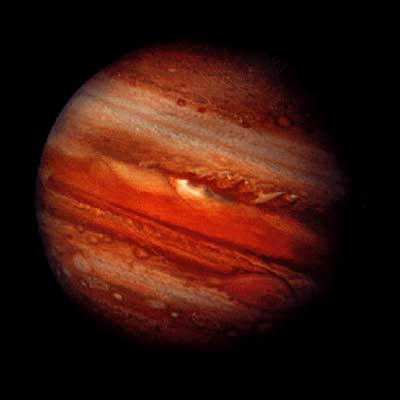
Jupiter is the largest planet in the solar system.
Jupiter is more than twice the mass as all the other planets
combined.
The great red spot on Jupiter has been seen
for more than 300 years
Jupiter is the fourth brightest object in the sky after the
Sun, the Moon and Venus.
Jupiter's four large moons are named Io, Europa, Ganymede, and
Callisto
Jupiter radiates more energy into space than it receives from
the Sun.
Jupiter protects the earth from impacts. Without Jupiter nearby,
long-period comets would collide with our planet up to 1000 times
more frequently.
In 1994 fragments of comet Shoemaker-Levy
9 collided with the planet Jupiter
Jupiter was the supreme god in the Romans religion. While not really a person this is the god from which the planet got its name. Many of the jupiter's moons have been named after Jupiter's daughters.
Jupiter has 4 major moons and many other moons. The discovery of the four major moons by Galileo
changed his and our view of the heavens. Watching them night after night
and plotting their positions, he realized that they were orbiting the
planet. This was an interesting proposition that would be considered
controversial in his day. In Galileo's time it was believed that the
Earth was the center of the universe, and that man was the most important
being on this sacred planet.
Jupiter is one of the two most enjoyable and rewarding planets to view
through a telescope. For most people, the first glimpse of Saturn is
their most memorable, but for longevity of rewards, there is no equal
to Jupiter. There is so much activity to see in Jupiter's atmosphere.
Through a small telescope on a clear night you can see stripes on the
celestial sphere. With more power, bands of color appear.