
Messier 7: The Ptolemy Cluster
- Catalog
- M7 · NGC 6475
- Type
- Open cluster
- Constellation
- Scorpius
- Best season
- Summer evenings
- Magnitude
- 3.3
- Apparent size
- 80′
- Distance
- 900 light-years
- Position (J2000)
- 17h 53.9m, -34° 49′
- Best seen with
- Binoculars
- Discovered
- Ptolemy, 130
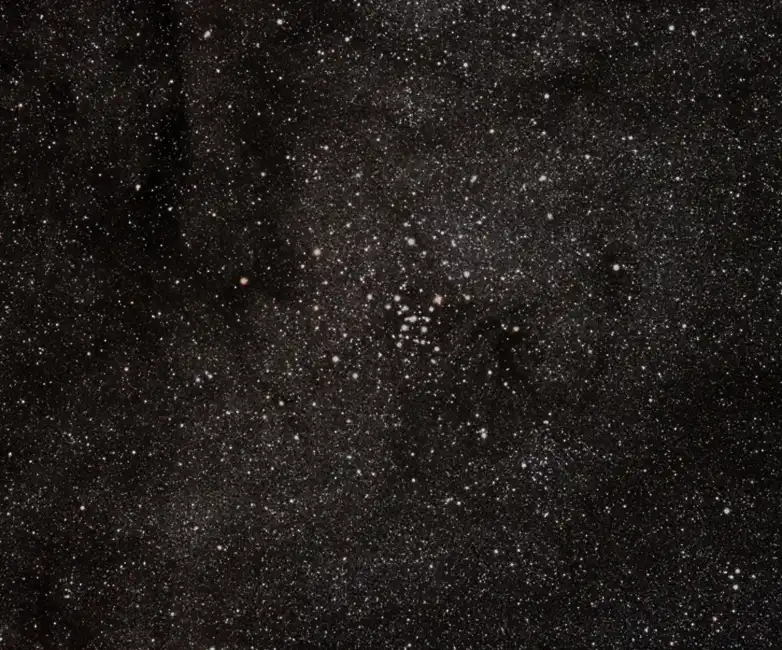
Messier 7, also known as the Ptolemy Cluster or NGC 6475, is a striking open star cluster located in the constellation Scorpius. This bright and prominent cluster contains around 80 stars, with an estimated age of about 200 million years. Its 80-arcminute spread (more than twice the width of the full Moon) spans about 20 light-years at a distance of roughly 900 light-years, making it one of the closest open clusters visible to the naked eye. Its stars shine primarily blue and white, hinting at their relatively young age.
Visually, Messier 7 is a stunning cluster, with its brightest stars creating a distinctive shape resembling a small kite or arrowhead. The stars vary in brightness, creating a beautiful display that amateur astronomers often describe as "sparkling" against the backdrop of the Milky Way.
Magnitude
Messier 7 has an apparent magnitude of +3.3, making it easily visible under dark skies without any optical aid. It’s one of the few Messier objects that can be seen with the naked eye, even in areas with mild light pollution. With binoculars or a small telescope, the cluster reveals dozens of stars, making it a favorite target for amateur astronomers.
Prominent Season and Constellation
Messier 7 is best observed in the summer months when the constellation Scorpius, in which it resides, dominates the southern sky. In the Northern Hemisphere, June through August is the ideal time to view this cluster; it is highest in the south around 10 p.m. in mid-July. M7 is the southernmost Messier object, so from about 40°N it never climbs more than about 15 degrees above the horizon, and you need a clear southern view. From the Southern Hemisphere it passes nearly overhead during the southern winter months.
Location and How to Find It with a Telescope
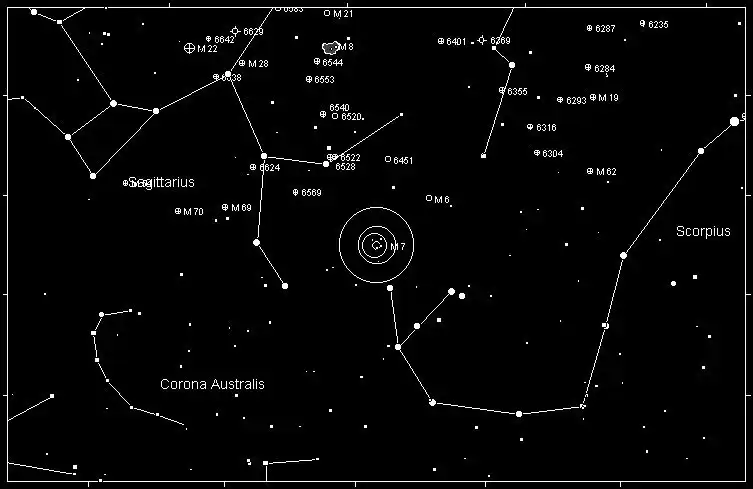
Messier 7 is situated in the "tail" of Scorpius, close to the bright star Shaula, which marks the stinger of the Scorpion. To locate Messier 7, start by finding the prominent red star Antares, which marks the heart of the Scorpion. From Antares, follow the arc of the constellation downwards toward the southern horizon. You’ll come across two bright stars, Shaula and Lesath, which form the Scorpion's sting. Messier 7 lies about 5 degrees northeast of Shaula, roughly halfway from the stinger to the spout of the Sagittarius Teapot (Gamma Sagittarii, about 5 degrees beyond the cluster).
Using binoculars or a small telescope with a low magnification setting will give you the best view. With a telescope, even at lower magnification, you can resolve many individual stars in the cluster. For more detail, increase magnification slightly, but be mindful not to lose the cluster’s overall context within its surroundings in the Milky Way.
History
Messier 7 has a rich observational history that spans back to antiquity. The Greek-Egyptian astronomer Claudius Ptolemy recorded the cluster around AD 130, describing it as a "nebula following the sting of Scorpius." This early reference earned it the name "Ptolemy's Cluster." Ptolemy’s description was significant for its time, as the term “nebula” referred to any extended celestial object that wasn’t a point source, which included star clusters like Messier 7.
Before 1654 the Sicilian astronomer Giovanni Battista Hodierna observed it with a telescope and counted about 30 stars in it, recognizing it as a collection of individual stars rather than a nebula. However, Messier 7 did not gain wide attention until Charles Messier included it in his famous catalog of nebulous objects on May 23, 1764. He listed it as the seventh entry, a considerable cluster of stars that looks like a nebulous patch to the naked eye.
In modern astronomy, Messier 7 continues to be a well-studied object, contributing to our understanding of stellar evolution and the dynamics of open star clusters. Its brightness and proximity make it a useful target for studying how stars that formed together at the same time develop.
Conclusion
Messier 7, the Ptolemy Cluster, is a beautiful and historic open star cluster located in the constellation Scorpius. With its easy visibility to the naked eye, binoculars, or small telescopes, it has captivated observers for centuries. Visible during summer nights in the Northern Hemisphere and winter months in the Southern Hemisphere, Messier 7 is a prime target for stargazers. Its place in the history of astronomy, stretching back to Ptolemy’s time, adds to its allure as one of the night sky’s jewels.