
The Complete Guide to Telescope Finders
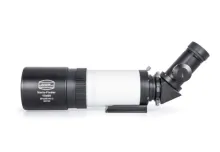
Telescope finders, often referred to simply as finderscopes, are crucial accessories for astronomers, both amateur and professional. They assist in locating celestial objects and aligning the primary telescope. This guide delves into the types, uses, and considerations when choosing a telescope finder.
What is a Telescope Finder?
A telescope finder is a small, auxiliary telescope or sighting device mounted on the main telescope. Its purpose is to help the user locate and center objects in the larger telescope's field of view. Because the field of view in a high-powered telescope is narrow, the finder provides a wider perspective, making it easier to locate objects.
Types of Telescope Finders
Red Dot Finders
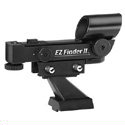
- Description: These are non-magnifying finders that project a red dot or reticle onto a glass screen.
- Advantages: Simple to use, no need to focus, lightweight, and typically inexpensive.
- Disadvantages: Limited precision for very faint objects, can be affected by bright surrounding lights.
Reflex Finders
- Description: Red dot finders are one kind of reflex sight; the wider family also includes finders that project rings or other reticles. All show the sky at 1x, with no magnification.
- Advantages: Wide field of view, ease of use, various reticle patterns for different observing needs.
- Disadvantages: Generally more expensive than basic red dot finders, still limited for faint objects.
Optical Finder-scopes
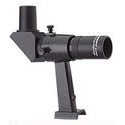
- Description: Small telescopes with low magnification and crosshairs to aid in targeting. Common sizes are 6×30, 8×50 and 9×50 (magnification × aperture in mm), showing roughly 5° to 7° of sky. They come in straight-through and right-angle versions, and some right-angle models give a correct (upright, unreversed) image.
- Advantages: Provides magnification to see faint objects, usually with better precision than non-magnifying finders.
- Disadvantages: Can be bulkier, requires focusing, may need alignment adjustments.
Telrad Finders
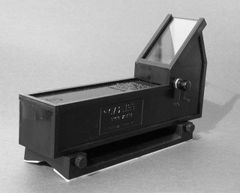
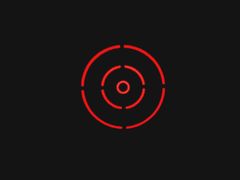
- Description: A reflex sight that projects three concentric red circles, 0.5°, 2° and 4° across, onto a glass window, showing where the telescope is pointed.
- Advantages: Very intuitive with its large, easy-to-see reticle, provides three circles for more accurate alignment, great for star hopping.
- Disadvantages: Bulkier than some other finders, requires batteries (two AA cells), and shows no stars fainter than the naked eye can see.
Choosing the Right Finder
When selecting a telescope finder, consider the following factors:
Purpose and Skill Level
- Beginners might prefer red dot or reflex finders for their simplicity.
- Intermediate and advanced users often add an optical finderscope or a Telrad for star hopping to fainter objects. Some use green laser pointers, but these are restricted or illegal in some countries and must never be aimed near aircraft.
Type of Observing
- Planetary and lunar observers might find non-magnifying finders sufficient.
- Deep-sky observers often benefit from the magnification of an optical finderscope or the versatility of a Telrad finder.
Telescope Compatibility
- Ensure the finder can be easily mounted on your telescope. Some telescopes come with built-in brackets for specific types of finders.
Environment and Conditions
- In light-polluted areas few naked-eye stars are visible, so an optical finder that shows fainter stars is a real help. Under dark skies any type works well.
Alignment and Calibration
Proper alignment of the finder with the main telescope is crucial for effective use. Follow these steps for alignment:
Daytime Alignment
- Point your main telescope at a distant, fixed object (like a radio tower or distant tree). Never point a telescope or finder anywhere near the Sun.
- Center the object in the telescope’s field of view.
- Adjust the finder so the object is centered in its crosshairs or reticle.
Nighttime Fine-Tuning
- Choose a bright star or planet.
- Center it in the main telescope.
- Adjust the finder for precision.
Maintenance and Care
- Clean the lenses periodically with a lens brush or blower to remove dust.
- Check alignment regularly, especially if the telescope is moved frequently.
- Replace batteries in illuminated finders, such as red dot finders and Telrads, and turn them off after use.
A well-chosen and properly aligned telescope finder can significantly enhance your stargazing experience. Whether you opt for a simple red dot finder, a sophisticated optical finderscope, or the versatile Telrad finder, understanding their uses and advantages will help you make the most of your time under the stars. Happy observing!
In this section
- Optical Finder-Scopes for Telescopes
When using a telescope for astronomical observations, locating celestial objects can be challenging. - Red Dot Finders for Telescopes: A Guide
Red dot finders are one of the most popular tools used by amateur astronomers to simplify the task of aligning a telescope to a specific… - Reflex Finders for Telescopes
Reflex finders, also called "unit-power" or "zero-power" finders (red dot finders are the most common kind), are standard accessories for… - Telrad Finders
The Telrad Finder is a non-magnifying sighting device used by amateur astronomers to locate and center objects in the night sky.