
Deep-Sky Targets for Astrophotography: The Messier Objects by Size
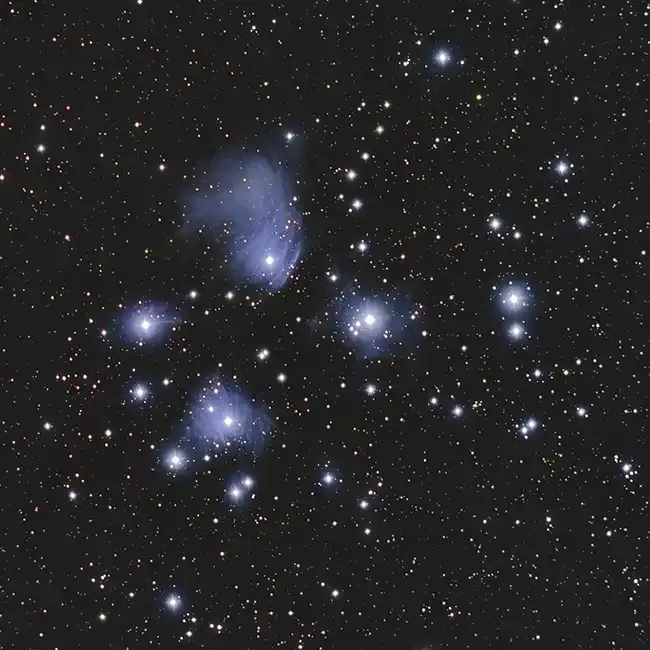
At the eyepiece you choose a target by brightness: can I see it from here? For a camera the first question is size: will it fit the frame, and will it fill enough of it to show detail? The Andromeda Galaxy is nearly six times the width of the full Moon and overflows the field of most telescopes, while the Ring Nebula is about a twentieth of the Moon's width and needs a long focal length to be more than a dot. Matching the target to the focal length you have is the single most useful habit in deep-sky imaging.
Focal length, sensor size and field of view
How much sky a camera sees depends on two things: the focal length of the lens or telescope, and the size of the sensor. Longer focal lengths and smaller sensors both give a narrower field. A rough guide:
| Setup | Field of view (approx.) | Good for |
|---|---|---|
| 135 mm lens, APS-C camera | 10° × 6.6° | The Orion region, the Pleiades with their surroundings, Milky Way star clouds |
| 250 mm smart telescope (small sensor) | about 1.3° × 0.7° | Large and medium nebulae, big clusters, the Andromeda Galaxy as a mosaic |
| 400 mm refractor, APS-C | 3.4° × 2.2° | The whole Andromeda Galaxy, the North America Nebula |
| 800 mm refractor or Newtonian, APS-C | 1.7° × 1.1° | Most nebulae, large galaxies, globular clusters |
| 2,000 mm compound telescope, APS-C | 40′ × 27′ | Small galaxies, planetary nebulae, the cores of globulars |
For your own combination, Webcam Astronomy's field of view calculator works out the field and shows whether your pixel scale suits your sky. Longer focal lengths also make tracking errors and poor seeing more visible, which is why most people start with a short refractor or a smart telescope and work up.
Good first targets by season
These are bright, well placed from mid-northern latitudes in the evening, and forgiving of a first attempt. Each links to its observing guide, which says when it is up and how to find it.
- Autumn: the Andromeda Galaxy (M31) with its companions M32 and M110; the Pleiades (M45), rising late in the evening; the Triangulum Galaxy (M33) from a dark site.
- Winter: the Orion Nebula (M42), the best first deep-sky target there is; the Crab Nebula (M1) for a longer focal length; the open clusters M35, M36, M37 and M38.
- Spring: Bode's Galaxy (M81) and the Cigar Galaxy (M82) in one frame; the Whirlpool Galaxy (M51); the Leo Triplet (M65, M66 and NGC 3628); the globular M3.
- Summer: the Great Hercules Cluster (M13); the Lagoon (M8) and Trifid (M20) nebulae together; the Eagle (M16) and Omega (M17) nebulae; the Dumbbell Nebula (M27).
From a light-polluted sky, lean towards the emission nebulae and clusters in these lists; imaging under light-polluted skies explains why.
All 110 Messier objects by size
Size is the object's largest dimension as listed on its page (′ = arcminutes; the full Moon is about 31′). The focal length is a starting point for a camera with an APS-C sensor; with full frame use about 1.5 times as much, with a small-sensor planetary or smart-telescope camera about half as much.
Large: 1° and bigger (8)
About 100–400 mm. A telephoto lens on a star tracker, a small refractor, or a smart telescope (several of these need a mosaic).
| Object | Name | Type | Size | Mag. | Best season |
|---|---|---|---|---|---|
| M31 | Andromeda Galaxy | Spiral galaxy | 178′ × 63′ | 3.1 | Autumn |
| M45 | Pleiades | Open cluster | 110′ | 1.6 | Winter |
| M44 | Beehive Cluster | Open cluster | 95′ | 3.7 | Winter |
| M8 | Lagoon Nebula | Emission nebula | 90′ × 40′ | 4.6 | Summer |
| M24 | Small Sagittarius Star Cloud | Star cloud | 90′ | 2.5 | Summer |
| M42 | Orion Nebula | Emission and reflection nebula | 85′ × 60′ | 4 | Winter |
| M7 | Ptolemy's Cluster | Open cluster | 80′ | 3.3 | Summer |
| M33 | Triangulum Galaxy | Spiral galaxy | 73′ × 45′ | 5.7 | Autumn |
Medium: 20′ to 1° (23)
About 400–1,000 mm. A small refractor or a smart telescope; most of these fit a smart telescope's field in one frame.
| Object | Name | Type | Size | Mag. | Best season |
|---|---|---|---|---|---|
| M48 | An Open Cluster | Open cluster | 54′ | 5.5 | Winter |
| M41 | Open Star Cluster | Open cluster | 38′ | 4.5 | Winter |
| M4 | Globular Cluster | Globular cluster | 36′ | 5.9 | Summer |
| M34 | Open Cluster in Perseus | Open cluster | 35′ | 5.5 | Autumn |
| M22 | A Stunning Globular Cluster in Sagittarius | Globular cluster | 32′ | 5.1 | Summer |
| M25 | Open Cluster | Open cluster | 32′ | 4.6 | Summer |
| M39 | an Open Star Cluster | Open cluster | 32′ | 4.6 | Autumn |
| M47 | Open Cluster in Puppis | Open cluster | 30′ | 4.4 | Winter |
| M67 | Open Star Cluster | Open cluster | 30′ | 6.1 | Winter |
| M20 | Trifid Nebula | Emission and reflection nebula | 28′ | 6.3 | Summer |
| M35 | Open Star Cluster | Open cluster | 28′ | 5.3 | Winter |
| M23 | A Bright Open Cluster | Open cluster | 27′ | 5.5 | Summer |
| M46 | Open Cluster in Puppis | Open cluster | 27′ | 6 | Winter |
| M6 | Butterfly Cluster | Open cluster | 25′ | 4.2 | Summer |
| M37 | Open Star Cluster | Open cluster | 24′ | 6.2 | Winter |
| M5 | Globular Cluster | Globular cluster | 23′ | 5.6 | Summer |
| M93 | Open Cluster in Puppis | Open cluster | 22′ | 6 | Winter |
| M101 | Pinwheel Galaxy | Spiral galaxy | 22′ | 7.9 | Spring |
| M38 | The Starfish Cluster | Open cluster | 21′ | 7.4 | Winter |
| M81 | Bode's Galaxy | Spiral galaxy | 21′ × 10′ | 6.9 | Spring |
| M10 | Globular Cluster in Ophiuchus | Globular cluster | 20′ | 6.4 | Summer |
| M13 | Hercules Globular Cluster | Globular cluster | 20′ | 5.8 | Summer |
| M43 | De Mairan's Nebula | Emission and reflection nebula | 20′ × 15′ | 9 | Winter |
Small: 8′ to 20′ (47)
About 1,000–2,000 mm. A larger refractor, a Newtonian or a compound telescope. A smart telescope shows them small, but cropping works for globular clusters.
| Object | Name | Type | Size | Mag. | Best season |
|---|---|---|---|---|---|
| M55 | Summer Rose Star Cluster | Globular cluster | 19′ | 6.3 | Summer |
| M106 | Spiral Galaxy in Canes Venatici | Spiral galaxy | 19′ × 8′ | 8.4 | Spring |
| M3 | Globular Cluster | Globular cluster | 18′ | 6.2 | Spring |
| M15 | (M15): Globular Cluster | Globular cluster | 18′ | 6.2 | Autumn |
| M19 | Globular Cluster in Ophiuchus | Globular cluster | 17′ | 6.8 | Summer |
| M110 | Small Galaxy in Andromeda | Elliptical galaxy | 17′ × 10′ | 8 | Autumn |
| M2 | Globular Cluster in Aquarius | Globular cluster | 16′ | 6.3 | Autumn |
| M12 | Globular Cluster in Ophiuchus | Globular cluster | 16′ | 6.7 | Summer |
| M50 | Heart-Shaped Cluster in Monoceros | Open cluster | 16′ | 5.9 | Winter |
| M26 | An Open Cluster | Open cluster | 15′ | 8 | Summer |
| M62 | Globular Cluster in Ophiuchus | Globular cluster | 15′ | 6.6 | Summer |
| M11 | Wild Duck Cluster | Open cluster | 14′ | 6.3 | Summer |
| M92 | Globular Cluster | Globular cluster | 14′ | 6.3 | Summer |
| M21 | An Open Cluster in Sagittarius | Open cluster | 13′ | 6.5 | Summer |
| M52 | Open Cluster in Cassiopeia | Open cluster | 13′ | 7.3 | Autumn |
| M53 | Globular Cluster | Globular cluster | 13′ | 7.6 | Spring |
| M107 | Globular Cluster in Ophiuchus | Globular cluster | 13′ | 7.9 | Summer |
| M9 | Globular Cluster in Ophiuchus | Globular cluster | 12′ | 7.7 | Summer |
| M30 | Globular Cluster in Capricornus | Globular cluster | 12′ | 7.7 | Autumn |
| M36 | Open Star Cluster | Open cluster | 12′ | 6.3 | Winter |
| M54 | Globular Cluster | Globular cluster | 12′ | 7.6 | Summer |
| M28 | A Globular Cluster in Sagittarius | Globular cluster | 11.2′ | 6.8 | Summer |
| M14 | Globular Cluster in Ophiuchus | Globular cluster | 11′ | 7.6 | Summer |
| M17 | Omega Nebula | Emission nebula | 11′ | 6 | Summer |
| M51 | Whirlpool Galaxy | Spiral galaxy | 11′ × 7′ | 8.4 | Spring |
| M68 | Globular Cluster | Globular cluster | 11′ | 8 | Spring |
| M83 | Southern Pinwheel Galaxy | Spiral galaxy | 11′ × 10′ | 7.5 | Spring |
| M74 | Face-On Spiral Galaxy in Pisces | Spiral galaxy | 10.2′ × 9.5′ | 9.4 | Autumn |
| M63 | Sunflower Galaxy | Spiral galaxy | 10′ × 6′ | 8.6 | Spring |
| M80 | Globular Cluster in Scorpius | Globular cluster | 10′ | 7.3 | Summer |
| M69 | A Globular Cluster | Globular cluster | 9.8′ | 7.6 | Summer |
| M79 | Globular Cluster in Lepus | Globular cluster | 9.6′ | 8 | Winter |
| M90 | Spiral Galaxy in Virgo | Spiral galaxy | 9.5′ × 4.5′ | 9.5 | Spring |
| M98 | Edge-On Spiral Galaxy in Coma Berenices | Spiral galaxy | 9.5′ × 3.2′ | 10.1 | Spring |
| M64 | Black Eye Galaxy | Spiral galaxy | 9.3′ × 5.4′ | 8.5 | Spring |
| M18 | An Open Star Cluster | Open cluster | 9′ | 7.5 | Summer |
| M49 | Giant Elliptical Galaxy in Virgo | Elliptical galaxy | 9′ × 7.5′ | 8.4 | Spring |
| M82 | Cigar Galaxy | Spiral galaxy | 9′ × 4′ | 8.4 | Spring |
| M104 | Sombrero Galaxy | Spiral galaxy | 9′ × 4′ | 8 | Spring |
| M56 | A Globular Cluster | Globular cluster | 8.8′ | 8.3 | Summer |
| M27 | Dumbbell Nebula | Planetary nebula | 8′ × 5.7′ | 7.5 | Summer |
| M32 | A Compact Elliptical Galaxy | Elliptical galaxy | 8′ × 6′ | 8.1 | Autumn |
| M65 | Spiral Galaxy in the Leo Triplet | Spiral galaxy | 8′ × 1.5′ | 9.3 | Spring |
| M66 | Spiral Galaxy in the Leo Triplet | Spiral galaxy | 8′ × 2.5′ | 8.9 | Spring |
| M70 | Globular Cluster | Globular cluster | 8′ | 7.9 | Summer |
| M78 | A Reflection Nebula | Reflection nebula | 8′ × 6′ | 8 | Winter |
| M108 | Edge-On Spiral Galaxy in Ursa Major | Barred spiral galaxy | 8′ × 1′ | 10 | Spring |
Very small: under 8′ (32)
2,000 mm and longer. Compound telescopes and long Newtonians. With anything shorter, expect a small object in a big frame.
| Object | Name | Type | Size | Mag. | Best season |
|---|---|---|---|---|---|
| M86 | Lenticular Galaxy in Virgo | Lenticular galaxy | 7.5′ × 5.5′ | 9.2 | Spring |
| M71 | Globular Cluster in Sagitta | Globular cluster | 7.2′ | 8.2 | Summer |
| M85 | Lenticular Galaxy in Coma Berenices | Lenticular galaxy | 7.1′ × 5.2′ | 9.2 | Spring |
| M16 | Eagle Nebula | Emission nebula | 7′ | 6 | Summer |
| M29 | An Open Star Cluster in Cygnus | Open cluster | 7′ | 7.1 | Summer |
| M60 | Giant Elliptical Galaxy in Virgo | Elliptical galaxy | 7′ × 6′ | 8.8 | Spring |
| M77 | Cetus A | Spiral galaxy | 7′ × 6′ | 8.9 | Autumn |
| M87 | Virgo A | Elliptical galaxy | 7′ | 8.6 | Spring |
| M88 | Spiral Galaxy in Coma Berenices | Spiral galaxy | 7′ × 4′ | 9.5 | Spring |
| M94 | Spiral Galaxy in Canes Venatici | Spiral galaxy | 7′ × 3′ | 8.2 | Spring |
| M100 | Grand-Design Spiral Galaxy in Coma Berenices | Spiral galaxy | 7′ × 6′ | 9.3 | Spring |
| M109 | Barred Spiral Galaxy in Ursa Major | Barred spiral galaxy | 7′ × 4′ | 9.8 | Spring |
| M75 | Globular Cluster | Globular cluster | 6.8′ | 8.6 | Summer |
| M72 | Globular Cluster in Aquarius | Globular cluster | 6.6′ | 9.4 | Summer |
| M1 | Crab Nebula | Supernova remnant | 6′ × 4′ | 8.4 | Winter |
| M61 | Barred Spiral Galaxy in Virgo | Barred spiral galaxy | 6′ × 5.5′ | 10.2 | Spring |
| M96 | Spiral Galaxy in Leo | Spiral galaxy | 6′ × 4′ | 9.2 | Spring |
| M103 | Open Cluster in Cassiopeia | Open cluster | 6′ | 7.4 | Autumn |
| M58 | Barred Spiral Galaxy in Virgo | Barred spiral galaxy | 5.5′ × 4.5′ | 9.8 | Spring |
| M91 | Barred Spiral Galaxy in Coma Berenices | Barred spiral galaxy | 5.4′ × 4.4′ | 10.2 | Spring |
| M99 | Spiral Galaxy in Coma Berenices | Spiral galaxy | 5.4′ × 4.8′ | 10.4 | Spring |
| M102 | Spindle Galaxy | Lenticular galaxy | 5.2′ × 2.3′ | 9.9 | Summer |
| M59 | Elliptical Galaxy in Virgo | Elliptical galaxy | 5′ × 3.5′ | 9.8 | Spring |
| M84 | Elliptical Galaxy in Virgo | Elliptical galaxy | 5′ | 9.1 | Spring |
| M95 | Barred Spiral Galaxy in Leo | Barred spiral galaxy | 4.4′ × 3.3′ | 9.7 | Spring |
| M89 | Elliptical Galaxy in Virgo | Elliptical galaxy | 4′ | 9.8 | Spring |
| M97 | Owl Nebula | Planetary nebula | 3.4′ × 3.3′ | 9.9 | Spring |
| M73 | Four-Star Asterism in Aquarius | Asterism | 2.8′ | 9 | Summer |
| M76 | Little Dumbbell Nebula | Planetary nebula | 2.7′ × 1.8′ | 10.1 | Autumn |
| M105 | Elliptical Galaxy in Leo | Elliptical galaxy | 2′ | 9.3 | Spring |
| M57 | Ring Nebula | Planetary nebula | 1.4′ × 1′ | 8.8 | Summer |
| M40 | Winnecke 4 | Double star | 0.8′ | 8.4 | Spring |
Beyond the Messier list
Many of the most photographed objects are not Messier objects at all, because Charles Messier was hunting for comets and listed only what could be mistaken for one through a small telescope. Large, faint nebulae such as the North America Nebula (NGC 7000), the Veil Nebula (NGC 6960 and 6992), the Rosette Nebula (NGC 2237) and the Heart and Soul Nebulae (IC 1805 and IC 1848) are too dim to have stood out to him, but they are large and bright in hydrogen-alpha light, and they are favourite targets for short refractors and smart telescopes, especially with a dual-band filter. Once the Messier list feels familiar, the Caldwell catalogue and planetarium software such as Stellarium are good places to look for more.