
Comet C/2023 A3 aka Tsuchinshan-ATLAS
This article was written in September 2024, ahead of the comet's appearance in our skies in the fall of 2024.
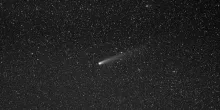
Image of comet Lovejoy from 2012
Comet C/2023 A3, also referred to as Tsuchinshan-ATLAS, was first spotted in early 2023 by observatories located in China and South Africa: the Tsuchinshan (Purple Mountain) Observatory found it in January, and the ATLAS survey telescope in South Africa picked it up independently in February. It comes from the Oort Cloud, the distant sphere of icy objects encircling our solar system's outermost reaches. Anticipated to be a celestial spectacle in late 2024, this comet reaches perihelion, its nearest approach to the Sun, on September 27, 2024.
Astronomy enthusiasts are abuzz with anticipation as the comet is predicted to become significantly brighter and potentially visible to the naked eye. Around October 9, 2024, it passes almost directly between the Sun and Earth, and sunlight scattered forward by its dust could briefly make it very bright, perhaps around magnitude -4, though it will be too close to the Sun to see easily then. The comet makes its nearest approach to Earth on October 12, 2024, at a distance of about 70 million kilometers, and from then on it should be seen in the western sky just after sunset.
Finding Comet C/2023 A3 (Tsuchinshan-ATLAS)
To find Comet C/2023 A3 (Tsuchinshan-ATLAS) in the night sky, you should follow these key steps:
- Optimal Viewing Dates: The comet should be best placed in the evening sky from about October 12, 2024, as it makes its nearest approach to Earth, and then fade slowly through the rest of the month. In mid-October it may be bright enough to see with the naked eye in clear, dark conditions.
- Gaze towards the Western Sky: Around October 13-14, look low in the west just after sunset. The comet climbs higher in the sky each night. In mid-October it moves from Virgo into Serpens Caput, and then into Ophiuchus around October 19.
- To accurately locate a celestial body, you can utilize star charts or astronomy apps such as SkySafari or Celestron's SkyPortal. These resources will assist you in finding the current position of the comet, tailored to your specific location and the time of your observation.
- Optimal Viewing Conditions: To enjoy the best possible view, head to a dark, rural location far from the glare of city lights. Allow around 30 minutes for your eyes to become accustomed to the dark. Employing binoculars or a telescope can significantly improve your view of the comet's tail and coma.
Comets are known for their unpredictability, and there have been worries regarding C/2023 A3 potentially fragmenting as it nears the Sun. In mid-2024, one study suggested its nucleus might be breaking up, but more recent observations show it still intact and brightening.
If the comet does remain intact, it could offer one of the most spectacular celestial events of the decade, visible with binoculars or even to the naked eye under ideal conditions. For the best viewing experience, it is recommended to observe from a dark location, away from city lights.
Postscript: The comet did survive. It put on a fine show in mid-October 2024, with a long tail visible to the naked eye and in photographs, then faded as it moved away from the Sun and Earth.