
Meteor Showers: Nature's Celestial Fireworks
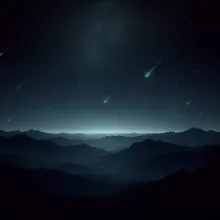
Imagine a clear night sky, punctuated by sudden streaks of light, like fleeting brushstrokes across the canvas of stars. These are meteors, often called "shooting stars." They have nothing to do with stars at all: each one is a speck of space debris burning up high in Earth's atmosphere. Here is what is really going on when you see one.
Meteoroid, meteor, meteorite
Three similar words describe the same object at different stages of its trip:
- Meteoroid - a small piece of rock or metal traveling through space. Most are tiny, no bigger than a grain of sand or a pebble. The International Astronomical Union uses the word for objects from about 30 micrometers up to about 1 meter across; anything bigger is called an asteroid.
- Meteor - the streak of light we see when a meteoroid plunges into the atmosphere. The meteor is the glow, not the rock.
- Meteorite - a piece that survives the fall and lands on the ground. Only larger, sturdier meteoroids make it this far. Most meteorites are pieces of asteroids; a few have been traced to the Moon and Mars.
Tiny particles that are too small to make a visible meteor, called micrometeoroids, also rain down all the time. NASA estimates that Earth sweeps up about 44 tonnes (about 48 tons) of this material every day, most of it as fine dust.
Fireballs and bolides
A fireball is simply a very bright meteor. Definitions vary a little, but a meteor brighter than about magnitude -3 or -4, around as bright as the planet Venus, is usually called a fireball. A fireball that explodes or breaks apart in a bright flash is called a bolide. Fireballs are caused by larger meteoroids, from marble-sized up to boulders, and some of them drop meteorites. They are rare at any one place, but if you watch the sky often you will eventually see one.
How fast and how high
Meteoroids hit the atmosphere at between about 11 and 72 kilometers per second (roughly 25,000 to 160,000 miles per hour). The slowest are ones catching up with Earth from behind; the fastest are ones meeting Earth head-on. At these speeds the air in front of the meteoroid is squeezed and heated so violently that the surface of the particle vaporizes. The glowing trail is made by the hot vapor and the air around it.
Most meteors light up and burn out between about 120 and 80 kilometers (75 to 50 miles) above the ground, far above airplanes and clouds. A typical meteor lasts less than a second. Faster meteors tend to start higher and burn out sooner. Some bright meteors leave a glowing train that can hang in the sky for a few seconds or longer.
Showers and sporadic meteors
On any dark night you can see a few random meteors an hour. These are called sporadic meteors. A meteor shower happens when Earth passes through a stream of debris shed by a comet (or, in a few cases, an asteroid). Because Earth crosses each stream at the same point in its orbit, the showers return on about the same dates every year: the Perseids in August, the Geminids in December, and so on.
All the meteors in a shower travel through space side by side, so perspective makes them seem to fly out from one spot in the sky, the radiant. A shower is named after the constellation near its radiant. Occasionally Earth hits an unusually dense part of a stream and a shower turns into a meteor storm. The Leonid storm of November 1833, seen across North America, produced tens of thousands of meteors an hour and helped launch the scientific study of meteors.
When to look
For the dates, peak rates and viewing tips for each shower, see our calendar of meteor showers through the year. A few general tips:
- Find a dark location away from city lights, and check that the Moon will not be bright that night.
- Give your eyes time to adjust. It takes 20 to 30 minutes for your eyes to adapt to the dark. Avoid looking at your phone.
- Look after midnight. Your side of Earth is then facing forward along its orbit, so more meteoroids hit the atmosphere above you.
- Lie back and take in a wide area of sky. No telescope or binoculars are needed; they show too small a piece of the sky.
- Dress warmly and be patient. Even in summer, nights can get chilly, and meteors often come in bunches with quiet spells in between.
Remember, the best way to observe a meteor shower is to be patient, relax, and enjoy the beauty of the night sky. Happy stargazing!