
News · Artemis · Moon · Missions
NASA details Artemis III docking test in Earth orbit ahead of 2028 landing
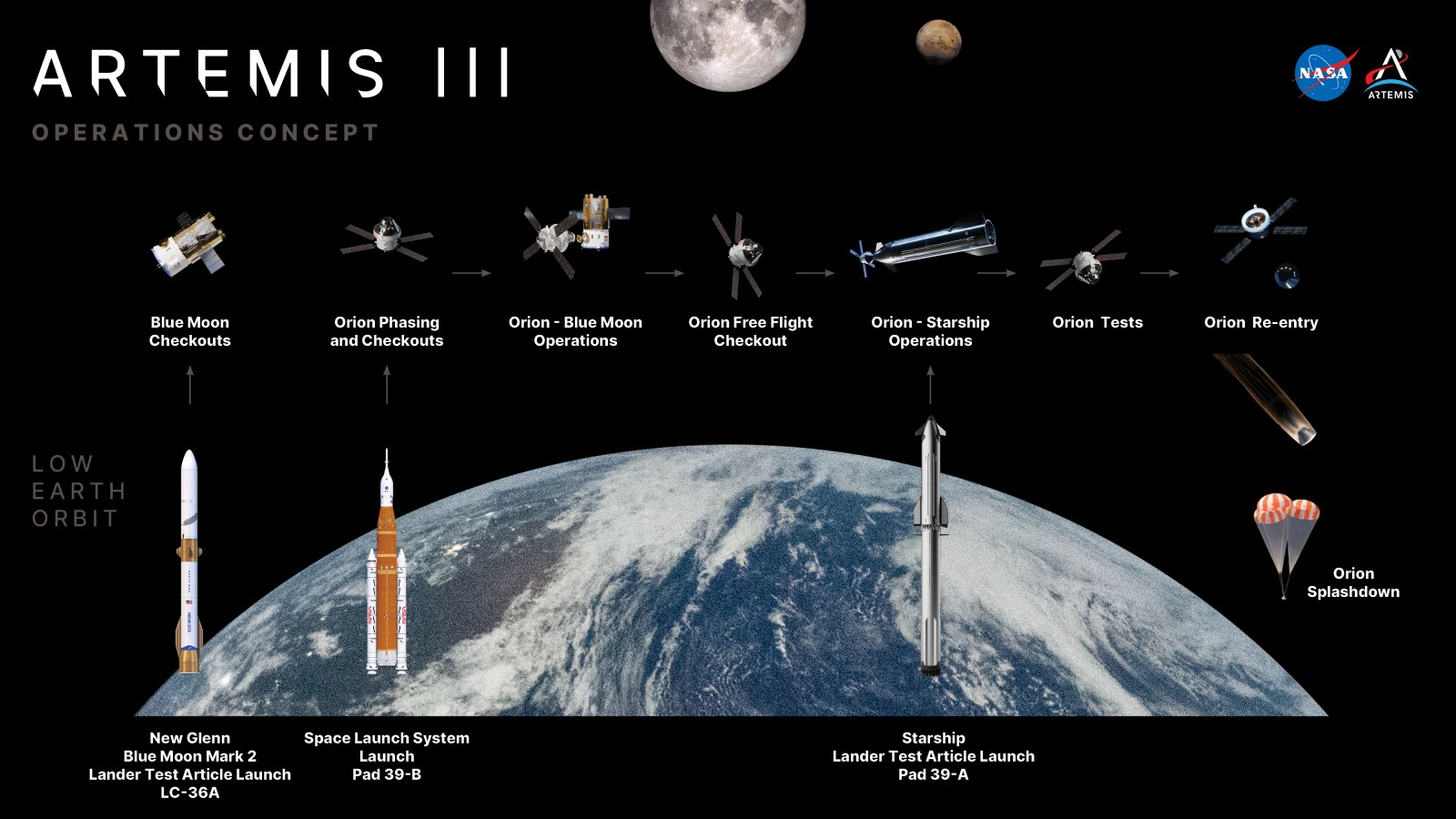
NASA has laid out in more detail how its next crewed Artemis flight will work and how it leads to a Moon landing in 2028. The plan was presented in an October 23 briefing led by Administrator Jared Isaacman and summarized by NASA on November 4, 2026.
Artemis III: a rehearsal close to home
Artemis III, planned for 2027, will not go to the Moon. Instead, four astronauts (NASA's Randy Bresnik, Frank Rubio and Andre Douglas, and ESA's Luca Parmitano) will launch on the Space Launch System rocket aboard Orion for a 14-day mission in Earth orbit. The goal is to practice the rendezvous and docking steps that a landing mission depends on, with test versions of both commercial Moon landers.
The sequence goes like this. Blue Origin first launches a Blue Moon lander test article into Earth orbit. SLS then launches Orion, which docks with it. Next SpaceX launches a Starship lander test article. Orion undocks from Blue Moon and docks with Starship. NASA says the crew will not go inside Starship during this test.
NASA reports the hardware is on track and that processing timelines have been cut roughly in half. As one example, the agency redesigned, built and tested a key fuel-line part in-house in five months, at about a tenth of an outside quote.
Artemis IV: the landing
Artemis IV, targeted for 2028, is planned to return American astronauts to the lunar surface, with the lunar south pole as the destination. NASA says it will decide later which lander provider goes first. Orion will launch on SLS from Kennedy Space Center. The landers no longer meet Orion in the wide, looping orbit around the Moon used in earlier plans. SpaceX's Starship will refuel in Earth orbit, meet Orion there, and carry it toward the Moon. Blue Origin's Blue Moon Mark 2 will be pushed toward the Moon by transfer stages and meet Orion in a closer lunar orbit before landing. Both companies are aiming to be ready in 2028.
NASA is also keeping two options for the SLS upper stage, and Axiom Space is building a lighter "Sortie suit," about half the weight of its main suit, for the first moonwalks.
Why it matters for skywatchers: these missions target the Moon's south pole, a region you can glimpse at the bottom edge of the Moon in a small telescope. Learn more about our neighbor and other worlds on our solar system page.
What comes next: NASA continues preparing Artemis III hardware for its 2027 flight, alongside the Moon Base cargo missions announced in November.