
News · Mars · Missions
Perseverance cores its first sample in over a year, possibly its oldest rock
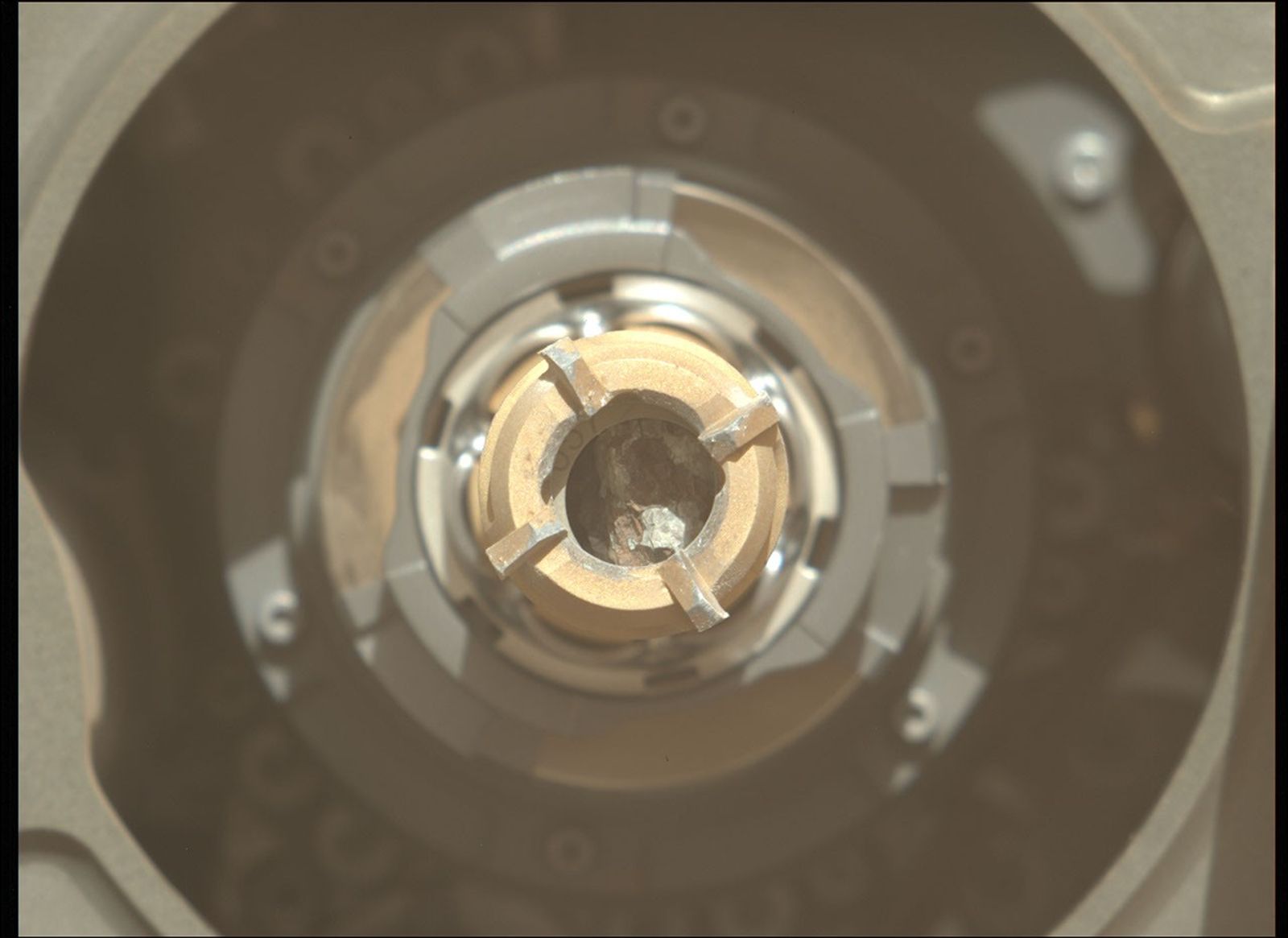
NASA's Perseverance rover has collected its first rock core in more than a year, and the team thinks it may be one of the oldest rocks in its whole collection. The sample, nicknamed "Singita," was drilled in late October 2026 on the ancient terrain just outside the rim of Jezero Crater.
A hard-won core
Singita is a gabbro, a coarse-grained igneous rock that cools slowly deep underground. The team had wanted a gabbro in the sample set for a while. An earlier target, "Badger Peak," turned out to be too hard to core, so this time engineers chose a flatter neighboring rock about 330 feet (100 meters) away and switched to a less-worn coring bit. The drill went about 1.2 inches (3.1 centimeters) into the rock, and a camera photo on sol 2018 (October 24) confirmed the core was in the tube.
The rock's textures suggest it formed deep in the Martian crust and was later broken up and dug out by at least one large impact, and maybe several. That makes it a possible window into the planet's early crust, which is exactly what scientists hope to study in samples brought back to Earth one day.
Ruby's mineral, on Mars
In a separate update, SuperCam principal investigator Roger Wiens of Purdue University described an unexpected find in light-colored rocks nearby. When SuperCam's laser hit one of them, the rock gave off a sharp, delayed glow at two red wavelengths. The team traced it to chromium atoms inside corundum, the mineral that, with chromium in it, is known on Earth as ruby. The results were published earlier this year in Geophysical Research Letters by a team led by Ann Ollila.
No gem-sized rubies have turned up, but the crystals are still a clue. On Earth, corundum usually forms through metamorphism driven by plate tectonics, which Mars lacks. On Mars, the long heating after a giant impact may have done the job instead. The team now routinely checks light-toned rocks for this glow as a sign of past impacts.
You can see Mars yourself before dawn this month in the eastern sky near Jupiter. Learn more on our Mars page.
What comes next: Perseverance continues exploring the "Lac de Charmes" area beyond the crater rim under its first mission extension, which runs to about the end of 2028.