
News · Webb · Galaxies
Webb pins down the most distant fast radio burst yet, in a tiny young galaxy
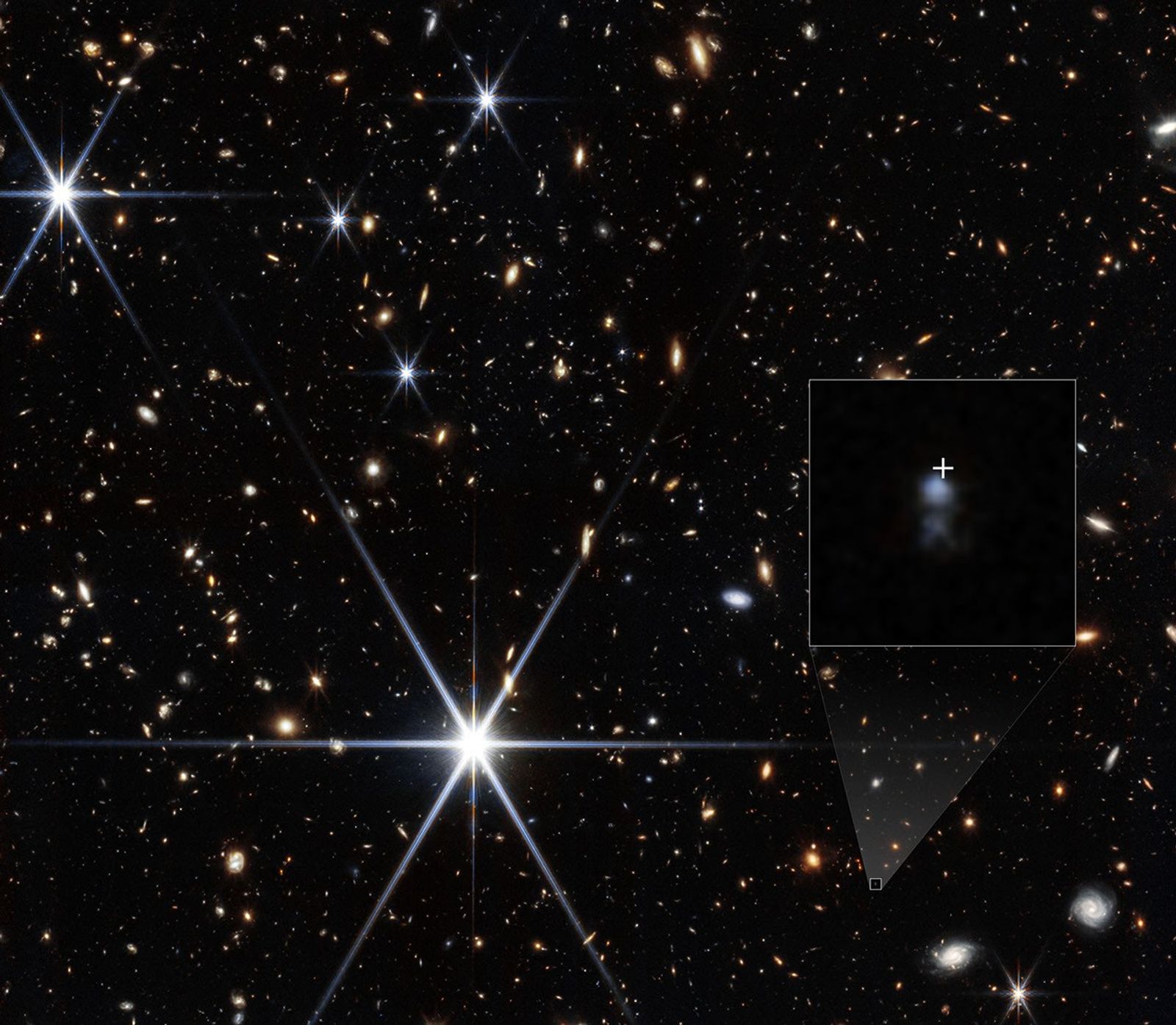
Fast radio bursts are flashes of radio waves that last only milliseconds but can come from billions of light-years away. Nobody is sure what makes them. Now the James Webb Space Telescope has found the home of the most distant one confirmed so far, and the answer surprised the team. The result was announced on October 8, 2026, and published in the journal Science.
A burst with no visible host
The burst, called FRB 20240304B, was caught on March 4, 2024, by the MeerTRAP team using the MeerKAT radio telescope in South Africa. The radio signal hinted that it came from very far away, but proving that meant finding the galaxy it came from, and big ground-based telescopes saw nothing at that spot.
Webb did. Its near-infrared camera found a faint galaxy at the burst's position, and its spectrograph measured a redshift of 2.148. That means the light left about 3 billion years after the Big Bang, during "cosmic noon," when galaxies were forming stars fastest.
Small, young and busy
The host turned out to be a dwarf galaxy, about 1,000 times less massive than the team expected, with most of its stars formed within roughly the last 30 million years. "Instead it was a little dwarf galaxy," said lead author Manisha Caleb of the University of Sydney.
That matters for the origin question. One idea is that bursts come from merging neutron stars, a process that takes billions of years and so should favor old galaxies. The other is a magnetar: a young, intensely magnetic neutron star left over from a recent supernova, producing bursts through "starquakes." A galaxy this young fits the magnetar picture, and the team says a merger origin for this burst is very unlikely.
The burst also acted as a probe of the space it crossed. Its signal carried traces of a previously unknown galaxy cluster about 3.5 billion light-years away and of the nearby Virgo Cluster, which backyard observers know as the home of bright galaxies such as M87 and M49.
What comes next: the team expects MeerKAT to find and pinpoint several similarly distant bursts each year, and Webb will be needed to study their host galaxies.